ElectroTouch
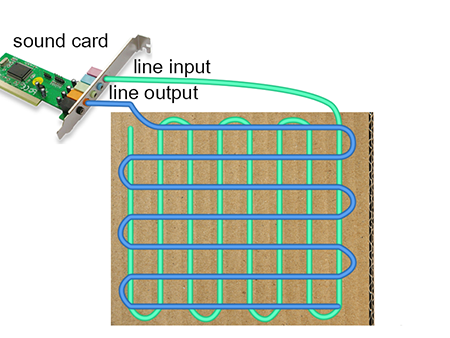
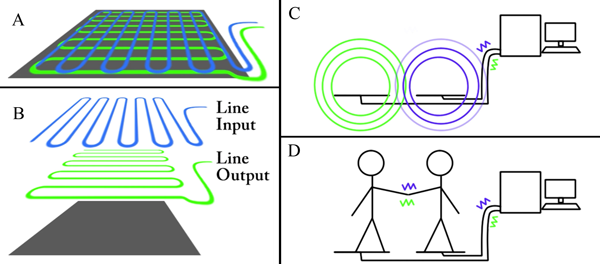
The ElectroTouch system built using antenna pads (A) connect to the line input and line output (B) of a soundcard creating EM waves (C) which are passed through a person’s body and can be detected when two people touch (D).
Electrotouch is a unique method that can detect contact between two or more individuals. People extend an electromagnetic (EM) field by standing on wire-woven pads. The wires on the pads are two separate insulated copper wires (like that found in Ethernet cable) that are taped to a piece of cardboard measuring approximately 0.5 m × 0.5 m. One wire is for transmitting and the other wire is for receiving. The wires from the pads are connected to line inputs and outputs of a common computer sound card using a shielded electrical cable.
The computer continuously sends sinusoidal signals, in the range of 16–19 kHz, to each of the pads (a different signal to each pad), and senses the signals coming back. In its neutral state, each pad will sense the same signal it emits. However, when users stand on the pads and make physical contact, they establish a weak electrical circuit connecting the corresponding pads. When this occurs, the sound card receives more than one signal from a pad: an original signal, and a signal of a different frequency, representing the pad of the touching user. The process is symmetric: when two people make contact, each of the two pads will be sensing the output of the other – this effect can be used to add redundancy.
The signals received from the pads are processed with the Fast Fourier Transform (FFT) in order to observe the signal magnitudes at all frequencies of the received spectrum. If the signals from the neighbouring pads rise above a certain dynamically-adjusted threshold, the system detects a ‘touch’ between those pads. Setting the threshold dynamically substantially increased the reliability of the system with people wearing dissimilar types of footwear.
ElectroTouch Pad Code
Download the ElectroTouch Software here by clicking on 'Branches' and download the master